

Trinity College Dublin Policy for the Acceptance of Gifts and Donations
1. Trinity Development & Alumni (TDA) is a charitable body tasked with receiving, administering and applying any funds and properties donated for the benefit of Trinity College Dublin. Trustees may accept, hold and apply any sums of money, funds, investments or property of any kind, for furthering the aims of the University generally; for maintaining, improving and developing the facilities for the teaching of undergraduates; for postgraduate work; for research; or for any other object of Trinity College Dublin, provided that such objects are exclusively charitable or educational.
2. All donations offered to Trinity College Dublin should be received and administered through TDA, though occasionally there will be circumstances that will necessitate the gift being received directly by the University, in those cases TDA must be made aware of the gift.
3. This policy applies to all types of gifts or donation, including cash, pledges, legacies/bequests, stocks/shares, and gifts-in-kind of equipment, artwork, software or other non-monetary gift. For the purpose of this document the terms 'gift' and 'donation' mean the same thing; that is a transfer of money or assets by a donor, made with philanthropic intent. After receipt, the donation must be owned in full by the University and the University must retain complete ownership of any resultant work or project. The donor must not retain any explicit or implicit control over a donation after acceptance by TDA.
4. Where individuals, schools and faculties wish to engage in philanthropic conversations they should consult with TDA at the earliest stage.
5. The University's selection criteria for student admissions are fully independent of philanthropic support of the institution. In addition, any donation will not affect the academic record of any current or future students nor have a bearing on any dispute between a student and the University about the outcome of his/her programme of study. The University's selection criteria for the recruitment of its staff and any research agendas are also fully independent of philanthropic support of the institution.
6. All donations of €25,000 or more will be subject to due diligence of some form. The extent of due diligence and of oversight applied will increase in line with an assessment of the risk associated with the potential donor and the potential size of the donation.
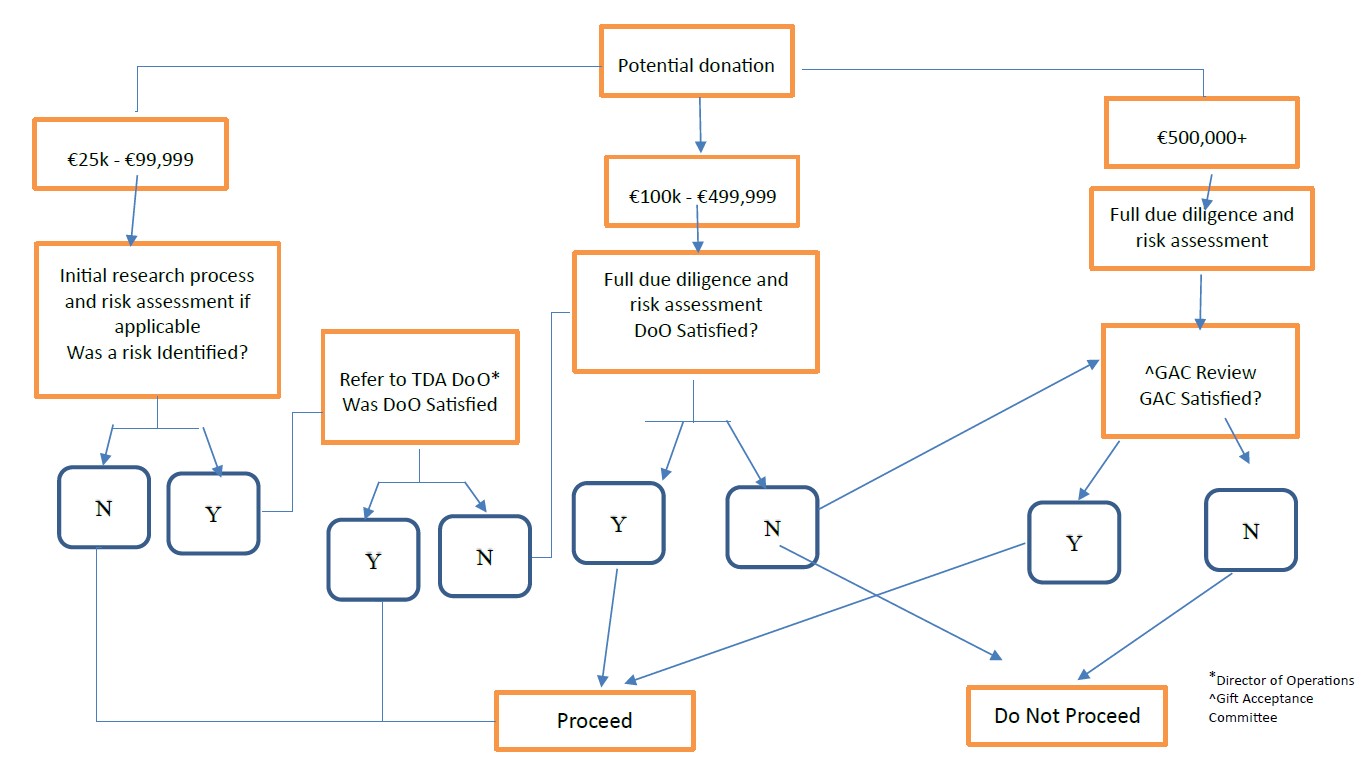
7. All proposed donations from sources which together with prior donations received by TDA, or directly to the University, amounting to between €25,000 and €499,999 as recorded on the TDA database, will be subject to a risk assessment to determine whether a more formal review is required. Cases will be referred to the TDA Director of Operations, who will, after discussion with the Chief Advancement Officer, decide whether the philanthropic conversation can proceed or whether the case should be referred to the Gift Acceptance Committee (GAC) for further consideration.
8. When TDA are informed of a donor's intention to pledge a legacy gift or bequest, an initial due diligence review will take place on the legator. When TDA are informed that a realised legacy gift will be transferred to the University by the estate of the legator a subsequent risk assessment will take place based on the confirmed value of the donation.
9. The GAC may decide to disclaim a legacy gift in the following circumstances:
- Conditional gifts: If the gift comes with specific, restrictive conditions that the University cannot realistically fulfil, for example, if a gift is restricted to a purpose that is no longer relevant or feasible for the University and once all options to amend the purpose have been explored (including a Cy-Pres application)
- Legacy gifts that are not aligned with Trinity's charitable purpose: The University cannot accept a gift that is for a purpose outside of its charitable objectives (as above, all options to amend the purpose will have been explored prior to a legacy gift being disclaimed).
- Administrative burden: A gift may be too difficult or costly for the University to administer. This could include complex assets or property that are difficult to sell or manage.
- Legal or ethical concerns: A legacy gift may be refused if the due diligence report indicates concerns about its origin or if accepting it would conflict with University ethical policies or values, or if the reaction of other donors/alumni to the acceptance of the gift is assessed as being likely to negatively impact TDA's future fundraising.
In the exceptional circumstances where the GAC decides to declaim a gift, its reasoning will be set out in a memo which will be issued to the Estate's solicitor.
10. The Gift Acceptance Committee (GAC) shall comprise of, two members of the University's Executive Officer Group, three members of academic staff, a Trustee of Trinity Foundation, the University's Director of Communications, and two external members, one with an expertise in business ethics. The Chief Advancement Officer or her nominee will also be in attendance. The principal purpose of the GAC is to consider and advise on whether the sources and purposes of prospective donations and fundraising are ethically acceptable.
11. The engagement of any prospective donor with a gift capacity of €500,000 or more and the acceptance of gifts or donations to the value of €500,000 or more or where the current gift will bring the total value of gifts received from that donor to €500,000 or more, shall be subject to approval by the Gift Acceptance Committee.
12. The Committee will also consider prospective donors with a gift capacity of less than €500,000 when the TDA Director of Operations and/or the Chief Advancement Officer, on review of the due diligence and risk report on that donor, are of the opinion that the Committee's review and consideration is warranted.
13. The purpose of the GAC is to safeguard the University's reputation by reviewing gifts in light of the criteria set out below; the Committee will not set unreasonably high standards for donors and will make decisions cognizant of the significant benefit the University accrues from philanthropy. The GAC will take account of the wider University policy framework and ensure that its decisions are aligned with the University's Ethics Policy. Its members will be guided by the University's Vision, Mission and Values as set out in the Strategic Plan and in particular by the following criteria in deciding whether or not to accept a gift:
- TDA will not engage with potential donors nor accept gifts that require action that is illegal or where there is any reason to suspect that the proposed gift may be from a source that arises in whole or in part from an illegal activity.
- TDA will not accept a gift where there is an expectation of personal advancement or influence. In particular, TDA will not entertain any pressure to link a gift with any student or staff application to the University, degree results, or any act that constrains academic freedom.
- TDA will not enter into a relationship with potential donors nor accept gifts that may seriously damage the reputation of Trinity College Dublin or harm its relationship with other key stakeholders or where acceptance is likely to deter a significant number of supporters from future support.
- TDA will only accept gifts that fit with the University's strategic mission and values, and that do not cost more than the benefit derived from the gift.
- TDA will not usually accept anonymous donations. TDA will, however, respect a donor's wish for privacy should they wish their details not to be published.
- TDA will not accept gifts where a donor's reputation has been compromised to the extent that an association with the donor would not be consistent with the mission and values of the University.
14. If any potential donor or gift should give rise to concern in light of these principles then they should be referred to the Gift Acceptance Committee for consideration, regardless of the amount of the donation.
15. For oversight purposes the GAC will also receive a summary table of all donations from donors which were reviewed and approved by the TDA Director of Operations.
16. Where the donor has previously been approved, there will be an assumption that any subsequent funding will also be approved unless:
- the proposed funding will reach the threshold requiring due diligence; or
- in the interim there has been a change in circumstance that might affect the University's decision as to whether to accept the subsequent funding.
17. Where gifts are received from a Foundation or other charitable entity, TDA will take all reasonable steps to ensure that the funding sources for that charity are consistent with this Gift Policy. Where charities send audited accounts to, and have full and current approved status with, a recognised national regulatory body for charities, further due diligence on the sources of funding of those charities will not typically be undertaken, unless there are reasons to believe that reputational risk may be involved. Those reasons may include, for example, any current or recent investigation into the activities of the charity by the relevant regulatory body.
Procedure if donation requires withdrawal
18. In recognition of the need to be aware of existing as well as proposed donations, withdrawal of an existing donation may be required in exceptional circumstances.
19. If there is concern over the ethical implications of an existing donation, regardless of the value of the donation, University staff are requested to notify the Chief Advancement Officer who will be responsible for bringing the matter to the GAC if appropriate.
20. In this scenario a full due diligence review will be undertaken and presented to the GAC who will then submit a recommended course of action to the University's Executive Officers Group.
Gift Acceptance Procedure
21. Written records must be kept for all donations to TDA. At a minimum this must include the donor's name, their contact details, the amount and date of the gift and the specific allocation of the gift if there is one. TDA will endeavour to put in place a gift agreement with the donor for all gifts above €10,000, detailing the above information.
22. While every effort will be made to ensure a signed Gift Agreement is on file for all donations in excess of €10,000, there may be occasions where the donor is unwilling to sign an agreement. In these circumstances the TDA fundraiser will clearly set out their understanding of the donor's wishes (restrictions) by email and send to the donor. This will be maintained on file to record the quantum of the gift, payment terms and any restriction which TDA understands the donor wishes placed on their gift.
23. Gift Agreements must be co-signed by the relevant person in the School or University Area to whom the gift is being made:
- Gifts under €100,000 will be signed by the TDA fundraiser responsible for the gift
- Gifts greater than €100,000 will be signed by the Director of Development
- Gifts of €1,000,000+ will be signed on behalf of TDA by the Chief Advancement Officer.
24. The Chief Advancement Officer will ensure that the Provost is appraised of all gifts received in excess of €1,000,000.
25. If the gift is from a Foundation or other charitable entity, their standard award letter will suffice as a Gift Agreement.
Financial Accountability
26. TDA's financial affairs will be conducted in a responsible manner, consistent with the ethical obligations of stewardship and the legal requirement of national regulators.
27. All donations will be used to support Trinity College Dublin.
28. All restricted donations will be used as agreed with the donor. If necessary, due to programme or organisational changes, alternatives will be discussed where possible with the donor or the donor's legal designate(s). If the donor is deceased or legally incompetent, and the University is unable to contact a legal designate, the donation will be used in a manner that is as consistent as possible with the donor's original intent.
29. The University will not change the purpose of any gift without first liaising with TDA who will discuss the proposal with the donor or their representative. Only on confirmation from TDA that the proposal has been accepted will the University then apply the gift to the new purpose.
Gift Acceptance Process
Procedure by Level of Donation
| Level of (potential) donation | Procedure | Outcome | Risk Template |
|---|---|---|---|
| Level 1 €25,000 - €99,999 |
Newspaper database and internet search on key words* to identify potential reputational risk | No risk – no further action Potential risk – complete risk scoring and refer to Director of Operations |
Not required Complete and submit to Director of Operations |
| Level 2 €100,000 - €499,999 |
Full due diligence process + risk scoring | If risk is 0 – confirm and approve If risk is 1 – refer to Director of Operations If risk is 2 – Refer to GAC |
Complete Complete and submit to Director of Operations |
| Level 3 €500,000 plus |
Full due diligence process + risk scoring and review by GAC | Refer to GAC | Complete and submit to GAC |
* search words to include: allegation, accusation, bankruptcy, bribe, fine, controversy, corruption, court, crime, donation(s), dissolved, equality, fraud, human rights, (il)legal, investigat(e/ion), prosecut(e/ion), protest, (un)ethical, sanction, scandal, terrorism, disqualification, drug(s) dealing, narcotic, prostitution, money laundering, tax evasion, human trafficking, slavery
Procedure for Legacy Donations
All legacy pledges, bequests and gifts must undergo a due diligence process in accordance with TDA's Gift Acceptance Policy. However, given the nature of these gifts, the due diligence process is not based on financial amount but on the stage of the gift.
| Level of (potential) legacy | Procedure | Outcome | Risk Template |
|---|---|---|---|
| Level 1 Legacy pledged – TDA is informed of a donor’s intent to leave a legacy gift |
Newspaper database and internet search on key words* to identify potential reputational risks | No risk – no further action Potential risk – complete risk scoring and refer to Director of Operations |
Not required Complete and submit to Director of Operations |
| Level 2 Legacy realised - TDA receives formal notification by a Solicitor or Estate that a donor, now deceased, has left a bequest to the University. |
Full due diligence process + risk scoring. If the value of the realised legacy gift is confirmed to be €500,000+ then the case will be referred to the GAC as per the normal due diligence process | If risk is 0 and gift is below €500,000 – confirm and approve If risk is 1 and gift is below €500,000 – refer to Director of Operations If risk is 2 or above €500,000 – Refer to GAC |
Complete Complete and submit to Director of Operations |
| Level 3 €500,000 plus |
Full due diligence process + risk scoring and review by GAC | Refer to GAC | Complete and submit to GAC |
* search words to include: allegation, accusation, bankruptcy, bribe, fine, controversy, corruption, court, crime, donation(s), dissolved, equality, fraud, human rights, (il)legal, investigat(e/ion), prosecut(e/ion), protest, (un)ethical, sanction, scandal, terrorism, disqualification, drug(s) dealing, narcotic, prostitution, money laundering, tax evasion, human trafficking, slavery
Risk Assessment Scoring
| Risk Rating | Score | Source of Donation |
|---|---|---|
| Low | 1 | Minor rumour/speculation/protest at behaviour by the proposed individual or organisational donor, considered by some to be unethical (but legal) |
| Medium | 2 | Significant rumour/speculation/protest at behaviour by the proposed individual or organisational donor, which is considered by some to be unethical (but legal) Or Allegations of illegality or unethical activity by an individual or organisation which is not the direct source of funding, but is nonetheless closely associated with the Donor |
| High | 3 | Unproven allegations or rumour/speculation of illegal activity by the proposed individual or organisational donor, where the illegal activity relates directly to the source of funding for the donation, or can be reasonably assumed to be a significant underlying source of funding for the donation Or Proven (in court of law) allegations of illegal activity by a proposed individual or organisation which is not directly connected to the source of funding, but is nonetheless closely associated with that source |
Decision Tree
Last updated: March 2026